Accreditation Logo

“I have worked with Oscar for about 4 years now, and he has really helped me with my math journey. With his help and training, I managed to get on my state team for the National Math Olympiad various times, and even managed to get a gold medal in the Girls’ National Math Olympiad. He knows a lot about these topics and explains them very well — very consistent in keeping you on track for what you want to achieve.”

— National Olympiad gold medalist (coached by Oscar H.)

“Nikola is a fantastic tutor. He is very patient in explaining concepts and has a deep understanding of mathematics — number theory in particular. He explains everything in a natural and crystal-clear way.”

— Olympiad-track student (coached by Nikola V.)

“Zurab stands out for his exceptional blend of deep expertise in competitive physics and math and his ability to present complex material in a surprisingly accessible way. He takes the time to understand each boy’s strengths and weaknesses, crafting a personalized study plan that addresses their unique needs.”

— Parent of two competition-math students (coached by Zurab J.)

“Ashyr is well prepared for the lesson. We had good communication about the goal and plan. He demonstrated strong capabilities on teaching at the AIME or above level, and prepared homework for my son to work on. Looking forward to the next lesson!”

— Parent of olympiad-track student (coached by Ashyrgeldi A.)

Why Our IMO Coaching Wins

  • IMO-medalist instructors — coaches who have themselves competed at and medaled at the International Mathematical Olympiad. They know what a gold-medal proof reads like
  • Past national-team coaches — some of our instructors have trained their countries’ IMO teams and know how MOP and Team-USA selection actually work
  • Topic depth at olympiad standard — functional equations, advanced inequalities, projective and inversive geometry, combinatorial extremal arguments, deep number theory
  • USAMO → MOP → IMO pipeline: we coach the path. Top USAMO scorers earn MOP invitations; top MOP performers make Team USA
  • Real past IMO and USAMO papers on our platform — 6 proof problems, 4.5 hours per day, full grader-style critique on every solution
  • Year-round, time-zone flexible — serious olympiad training runs through summer; our coaches are on call when MOP and IMO actually happen
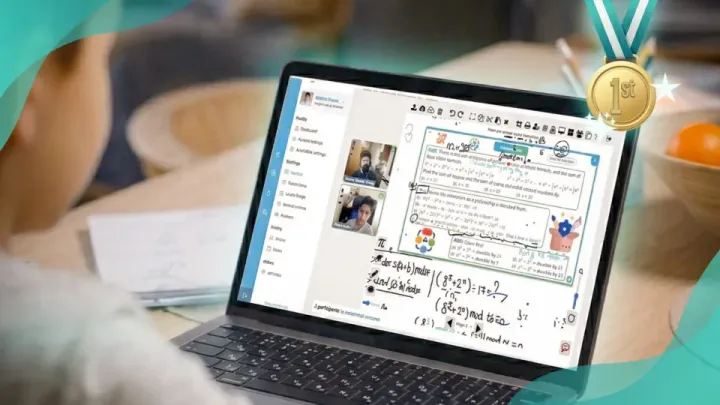
Live Video. Real Whiteboard. No Typing.

Most online IMO programs are group sessions with typed chat — slow, clunky, and disconnected. We use 1-on-1 live video with an interactive whiteboard:

  • See your tutor explain problems in real time
  • Draw geometry, write equations, sketch your thinking
  • Ask questions immediately — no chat lag
  • Watch IMO medalist coaches solve problems the way mathematicians actually work
Live 1-on-1 video lesson with interactive whiteboard

IMO Curriculum

The International Mathematical Olympiad (IMO) is the most prestigious mathematics competition for high school students worldwide. Six problems are administered over two days, with 4.5 hours each day, requiring complete proofs of olympiad-caliber problems calibrated to challenge the best high school mathematicians in the world. Each participating country sends a team of six students; the U.S. team is selected from the Mathematical Olympiad Program (MOP), which trains the top USAMO scorers.

IMO problems span the standard olympiad subjects — algebra, number theory, geometry, and combinatorics — but at a depth and integration far beyond national-level olympiads. Problems often combine techniques across topics: a problem may appear geometric but resolve via a combinatorial bijection, or appear algebraic but require number-theoretic insight. The skill being trained is not just solving problems but recognizing the underlying structure that connects seemingly disparate mathematical fields.

Our IMO curriculum is grounded in the international olympiad tradition, with particular emphasis on Russian and Eastern European pedagogy. The Soviet and Russian school produced disproportionate IMO success over decades — the techniques and recognition patterns refined there form the foundation of modern olympiad training worldwide. Several of our coaches competed in IMO themselves or in their national olympiads, and bring direct experience of what the test rewards.

The curriculum is organized by technique, with each section reaching the genuine depth required for IMO-caliber problems. Students at this level need not just knowledge of techniques but fluent recognition: knowing when a functional equation requires bounding versus substitution, when an inequality problem reduces to a known classical inequality versus requiring a novel approach, when a number-theoretic problem hinges on local-global obstructions.

Algebra

  • Lesson 1 · Functional Equations at IMO Depth

    Cauchy functional equations over , , and with their full classification under various regularity conditions. Pexider equations and their reduction to Cauchy. Functional equations with multiple variables: f(x, y), f(x + y, z), and their analysis. Functional inequalities and their relationship to equations. Boundedness and monotonicity as tools for forcing solutions. The technique of fixed points: finding x with f(x) = x and using the fixed point to constrain f globally. IMO problems where functional equation techniques apply across topic boundaries.

  • Lesson 2 · Polynomial Theory at Depth

    Vieta’s formulas and Newton’s identities in their full generality. Polynomial interpolation via Lagrange, Newton’s forward differences, and the divided differences formula. Resultants and the relationship between polynomial roots. Discriminants of polynomials of arbitrary degree. The fundamental theorem of algebra. Algebraic versus transcendental: when an IMO problem’s structure forces a polynomial answer to be algebraic. Hensel’s lemma at the level needed for olympiad problems.

  • Lesson 3 · Inequalities — The Full Toolkit

    AM-GM, Cauchy-Schwarz, rearrangement, Chebyshev, Jensen at full depth with all variants. Hölder’s inequality and its generalizations. Minkowski’s inequality. Power mean inequalities. The SOS method, tangent line techniques, Schur’s inequality. Identifying equality cases — at IMO level, problems often specifically test whether the equality case is correctly characterized. The substitution methods: a = x + y, b = y + z, c = z + x for triangle inequalities; u = a + b + c, v = ab + bc + ca, w = abc for symmetric polynomials in three variables. Recognizing when an inequality problem reduces to a single classical inequality versus requiring a multi-step argument.

  • Lesson 4 · Complex Numbers and Cyclotomic Polynomials

    Roots of unity and the cyclotomic polynomials Φn(x). Properties of Φn: degree φ(n), irreducibility over , the relationship Πd|n Φd(x) = xn − 1. Using cyclotomic polynomial structure in number theory and combinatorics. Complex bash for geometry: representing complex points, lines, circles in . Proving classical theorems (Napoleon’s theorem, the nine-point circle, the Simson line) via complex methods. The Lindemann-Weierstrass theorem at conceptual level — used in problems where transcendence considerations matter.

  • Lesson 5 · Sequences, Recurrences, and Asymptotics

    Linear recurrences with the characteristic equation in full generality, including repeated and complex roots. Nonlinear recurrences and their analysis. Ordinary and exponential generating functions. The Lagrange inversion formula at conceptual level for advanced generating function problems. Asymptotic estimates: when a problem requires bounding a sequence’s growth rate, decay rate, or behavior over many terms.

  • Lesson 6 · Galois Theory at Conceptual Level

    The framework of Galois theory: field extensions, automorphisms, the Galois group of a polynomial. Why certain constructions are impossible (trisecting an angle, doubling the cube, constructing a regular 7-gon). The conceptual framework matters for problems where the answer hinges on solvability properties — even without computing Galois groups directly, recognizing the underlying obstruction is the insight.

Number Theory

  • Lesson 1 · Modular Arithmetic and Classical Theorems

    Fermat’s Little Theorem, Euler’s theorem, Wilson’s theorem at full depth. The Chinese Remainder Theorem with its uses and the limits of its application. Primitive roots and the structure of (ℤ/pℤ)*. Discrete logarithms and indices. Quadratic residues and the Legendre symbol. Quadratic reciprocity with proof sketch and applications. Higher reciprocity at conceptual level.

  • Lesson 2 · p-adic Valuation and Lifting the Exponent

    The p-adic valuation vp with its full algebraic structure. Lifting the Exponent in complete generality, with all cases (odd p, p = 2, sums, differences). The Hasse principle: when local solvability implies global solvability for Diophantine equations. Newton polygons for analyzing polynomial roots p-adically. p-adic numbers at conceptual level — for problems where local obstructions matter.

  • Lesson 3 · Diophantine Equations and Their Techniques

    Linear and quadratic Diophantine equations and their full theory. Pell’s equation with the continued fraction approach to solutions. Vieta jumping in full form, including classical problems from IMO history (IMO 1988 Problem 6 being the canonical example). The method of infinite descent. Fermat’s method of factoring. Elliptic curves at conceptual level — IMO problems occasionally hinge on properties of elliptic curves without requiring the full theory.

  • Lesson 4 · Multiplicative Structure and Möbius Inversion

    Multiplicative arithmetic functions and Dirichlet convolution. Möbius inversion and its applications. Euler products. The relationship between multiplicative functions and Dirichlet series. Computing sums over divisors via multiplicative decomposition. The Mertens function and prime-counting estimates at conceptual level.

  • Lesson 5 · Algebraic Number Theory at Introductory Level

    Algebraic integers in quadratic fields ℤ[√d] and ℤ[ω] (Eisenstein integers). Unique factorization in these rings and the failure of unique factorization in general. Class numbers at conceptual level. Using quadratic field arithmetic to solve Diophantine problems that resist standard methods — for example, representing integers as sums of squares.

  • Lesson 6 · Constructive and Existence Proofs

    Construction of integers with prescribed properties. Non-existence proofs via modular obstructions, descent, or growth bounds. The interplay of additive and multiplicative structure in IMO problems. Parameterized families of solutions: constructing infinite families from finite cases. The technique of “smoothing”: modifying a candidate construction to satisfy additional constraints.

Geometry

  • Lesson 1 · Synthetic Geometry at IMO Depth

    The triangle centers and the full network of their relationships. The Euler line, the nine-point circle, the Feuerbach point and the Feuerbach circles. Isogonal and isotomic conjugates, isogonal lines, isogonal points. The Simson line and its generalizations. The Wallace-Bolyai-Gerwien theorem. Recurring olympiad configurations: the incircle-contact triangle, the medial triangle, the orthic triangle, the tangential triangle, the antimedial triangle, the pedal triangle of an arbitrary point.

  • Lesson 2 · Power of a Point, Radical Axes, and Coaxial Systems

    Power of a Point in full algebraic form. The radical axis as a locus and its alternative characterizations. Radical centers. Coaxial systems of circles: orthogonal coaxial systems, pencils of circles through two points, pencils tangent to a line. Using coaxial structure in problems involving multiple circles.

  • Lesson 3 · Cyclic Quadrilaterals, Ptolemy, and Beyond

    Cyclic quadrilateral properties at full depth. Ptolemy’s theorem and inequality with proof. Brahmagupta’s formula for cyclic quadrilateral area, with proof and applications. Generalizations of Ptolemy: Casey’s theorem for tangent circles. The relationship between cyclic quadrilaterals and the cross-ratio.

  • Lesson 4 · Geometric Transformations

    The full classification of plane isometries (translations, rotations, reflections, glide reflections) and similarities. Spiral similarities and their fixed points: the spiral similarity lemma in its full form. Compositions and the resulting transformation type. Möbius transformations as the most general angle-preserving maps in the plane (under inversion). Using transformations to map any configuration to a canonical one.

  • Lesson 5 · Inversion

    Inversion in a circle with full properties: line-to-line, line-to-circle, and circle-to-circle correspondences. Tangency preservation. Cross-ratio preservation. Inversion at a center on a circle. Computing the inverse of common configurations: triangles, cyclic quadrilaterals, tangent circles. The Apollonius problem solved via inversion. When inversion makes a problem trivial; when it requires careful choice of center and radius.

  • Lesson 6 · Projective Geometry

    Poles, polars, and the polar duality with respect to a conic. The cross-ratio of four collinear points or four concurrent lines or four concyclic points. Harmonic conjugates and harmonic ranges. Projective transformations: the projective plane, perspectivities, projectivities, and the fundamental theorem of projective geometry. The duality principle: every projective theorem has a dual statement. Pascal’s theorem and Brianchon’s theorem. When projective methods solve problems that synthetic and inversive methods cannot.

  • Lesson 7 · Coordinate, Complex, and Barycentric Bashing

    The full toolkit of coordinate methods. Cartesian coordinates for problems with axis-of-symmetry structure. Complex coordinates for problems involving rotations, similarities, or concyclicity. Barycentric coordinates for triangle-centric problems, including normalized barycentric and homogeneous barycentric. Areal coordinates and their relationship to barycentric. Trigonometric methods at olympiad depth: identities of arbitrary complexity, applied to angle-chasing problems where pure synthetic methods become infeasible.

  • Lesson 8 · Combinatorial Geometry

    Counting problems with geometric structure. Lattice points, lines, intersections, regions in the plane. The Erdős-Szekeres theorem and its proof via Ramsey theory. Helly’s theorem and its applications to convex sets. The Sylvester-Gallai theorem on points not in general position. Combinatorial geometry over finite fields. Geometric Ramsey theory: the Hales-Jewett theorem at conceptual level.

Combinatorics

  • Lesson 1 · Counting at IMO Depth

    Bijective arguments, double counting, inclusion-exclusion at olympiad depth. Catalan numbers and their many olympiad-relevant identities. Counting lattice paths via the reflection principle and the cycle lemma. Counting via algebraic methods: coefficient extraction from generating functions. The exponential formula. Counting with constraints: the principle of inclusion-exclusion applied to complex set systems.

  • Lesson 2 · Pigeonhole and Extremal Methods

    The pigeonhole principle in all its variants. Constructing the pigeons and the holes — typically the hard step in IMO pigeonhole problems. The extremal principle and the well-ordering principle as its foundation. Discrete extremal arguments. The probabilistic method as a generalization of pigeonhole. Recognizing when an existence problem is solvable by counting versus when it requires construction.

  • Lesson 3 · Invariants and Monovariants

    Invariants under operations allowed in a problem. Coloring arguments as invariants (mod 2, mod 3, more general). Constructing invariants from partial information. Monovariants and termination proofs for iterative processes. The relationship between invariants and group actions on configurations.

  • Lesson 4 · Graph Theory

    Graphs, trees, connectivity at full depth. Euler tours, Hamiltonian paths and cycles, planarity and the Euler formula. Bipartite graphs and matchings. Hall’s marriage theorem with proof. König’s theorem, max-flow min-cut. Ramsey theory: Ramsey numbers, the general Ramsey theorem, multi-color Ramsey theory at conceptual level. Extremal graph theory: Turán’s theorem, the Erdős-Ko-Rado theorem.

  • Lesson 5 · Combinatorial Games

    Two-player games with perfect information at olympiad depth. Nim, Sprague-Grundy theorem with full proof. Computing Grundy values. Strategy stealing arguments and the games they resolve. Pairing strategies. Games on graphs and on game trees. Hackenbush and surreal numbers at conceptual level.

  • Lesson 6 · The Probabilistic Method

    Existence proofs via random construction. Linearity of expectation as a proof tool. The deletion method and its applications. The Lovász local lemma with proof sketch and applications. Concentration inequalities: Markov, Chebyshev, Chernoff bounds at conceptual level. Random graphs and threshold phenomena.

  • Lesson 7 · Algebraic Methods in Combinatorics

    Linear algebra over finite fields applied to counting and existence problems. The dimension argument. The polynomial method: encoding combinatorial structure as polynomial vanishing conditions. Combinatorial nullstellensatz. The Plünnecke-Ruzsa inequality in additive combinatorics. Recent results in algebraic combinatorics that have produced IMO problems.

  • Lesson 8 · Additive and Combinatorial Number Theory

    Sumsets, sum-free sets, and the structure of additive sets. Cauchy-Davenport theorem with proof. The Erdős-Ginzburg-Ziv theorem and its generalizations. Schnirelmann density. Vinogradov’s three-primes theorem at conceptual level. Roth’s theorem on arithmetic progressions. The Szemerédi-Trotter theorem on point-line incidences.

Proof Writing

  • Lesson 1 · Anatomy of an IMO Solution

    The structure expected by IMO graders. Setting up the proof, identifying the key claim, proving the key claim, applying the claim to conclude. The distinction between a proof sketch and a complete proof. What may be cited (named theorems) versus what must be proved. The conventions of olympiad mathematical writing.

  • Lesson 2 · Writing for International Graders

    The discipline of writing for a grader who may not share your linguistic or pedagogical background. Clarity over cleverness. Justification at each non-obvious step. Handling edge cases explicitly. Defending each step against the most skeptical interpretation. The “would this convince a different country’s grader” test.

  • Lesson 3 · Proof Techniques at Depth

    Direct proof, contradiction, contrapositive at olympiad level. Induction in all its forms with their proper justifications. Strong induction, structural induction, double induction. Transfinite induction at conceptual level. Construction. Probabilistic proof. Algebraic proof. Choosing the right technique from the problem’s structure.

  • Lesson 4 · Editing for Excellence

    Reviewing one’s own proof at the highest level of rigor. Identifying gaps that a typical reader would miss. Editing for clarity without losing precision. The “explain to a peer” test applied to olympiad-level proofs. Refining geometry proofs with diagrams that support the verbal argument. Time management on a 4.5-hour exam: how to write a complete proof under time pressure.

Past Papers Practice

IMO mastery requires solving the hardest olympiad-caliber problems and writing complete, correct, well-presented proofs that meet international standards. Our students work through:

  • IMO papers from 2000 to 2025, with detailed analysis of each problem’s structure, the key insight required, and how to present the proof
  • IMO Shortlist problems from recent years — the problems considered for IMO but not selected, and the standard practice material for olympiad training worldwide
  • USAMO and Putnam problems for additional volume at comparable difficulty
  • Problems from other major national olympiads: Russian, Chinese, Eastern European
  • The standard olympiad references: Engel’s “Problem-Solving Strategies,” Andreescu and Enescu’s “Mathematical Olympiad Treasures,” Andreescu and Feng’s various problem collections, Djukić et al.’s “The IMO Compendium”

Practice is interleaved with technique-focused lessons throughout the program. Students at this level typically write 100+ proofs over a year of preparation, with each proof reviewed at IMO grader standards. Many of our coaches were IMO participants or near-participants themselves, and bring direct experience of what the test rewards.

Why Russian Math methodology shines at IMO. The Russian olympiad tradition developed in direct interaction with the IMO over decades. The techniques refined in Soviet and Russian mathematical schools — Vieta jumping, the SOS method, advanced inversion, generating functions, the probabilistic method, additive combinatorics — were largely codified through their use in IMO problems and the training of IMO teams. Our coaches were trained directly in this tradition and bring it to students preparing for the highest level of mathematical competition.

About the IMO

What is the IMO?

The International Mathematical Olympiad is the world championship of pre-college mathematics. More than 100 countries each send a team of up to 6 students, who compete individually over two consecutive days — 3 problems each day, 4.5 hours per session, max 42 points total.

Every answer is a complete written proof, graded 0–7 by an international jury. The U.S. team is chosen through a multi-stage funnel: AMC 10/12 → AIME → USAMO → MOP → team selection. Roughly six students per year wear the U.S. uniform at the IMO — the smallest, sharpest filter in American academic math.

Why IMO is the credential

An IMO medal is the most prestigious pre-college mathematics credential in the world. Past IMO medalists include Terence Tao, Maryam Mirzakhani, Grigori Perelman, Manjul Bhargava — multiple Fields Medalists started here. Top universities and graduate programs treat an IMO result as a near-decisive signal in admissions.

Even reaching MOP (the Mathematical Olympiad Program) — the 3-week summer camp from which the U.S. team is picked — is itself a major credential. MOP alumni populate the top mathematics, computer science, and quantitative research programs at MIT, Harvard, Princeton, Stanford, Caltech, and CMU.

What good IMO prep looks like

IMO problems demand creative synthesis at the world-class level. Standard olympiad techniques aren’t enough — gold-medal solutions combine deep number theory, projective and inversive geometry, advanced functional equations, generating-function combinatorics, and probabilistic / extremal arguments. Each year, two of the six problems are typically considered ‘world-finals hard.’

Our coaches teach the way they themselves trained for the IMO — working through past Shortlist, IMO, ISL, and country-team-selection problems, debugging proof drafts line by line, and stress-testing under timed conditions. Sessions alternate between untimed deep dives on a single hard problem (sometimes 90 minutes on one IMO problem) and timed mock IMO sittings for the 4.5-hour stamina the real exam demands. Students get grader-style feedback on every solution — the same critique an IMO jury would give.

IMO & U.S. Team Selection Calendar

Annual cycle
USAMO: late March (proof-based qualifier)
MOP (Math Olympiad Program): 3 weeks in June
IMO: July, host country rotates (recent: Australia 2025, China 2026, Brazil 2027)
Selection: invitation-only, top USAMO scorers → MOP → team of 6.

Per IMO host calendar and MAA selection rules. Dates and locations subject to change — verify on imo-official.org.

What Parents Are Saying